
How Oakley Residents Surface in Records
A useful Oakley residents directory search starts by naming the kind of fact needed. Property records can connect a parcel to an assessed owner and mailing address, but they do not list every person in a home. A court index can connect a name to a case role and date, but its public register is not the case file. A directory volume can place a household at an old address, while an obituary or probate file can explain a later change. City records begin after incorporation, while county records carry the earlier trail.
Use the clue that is least likely to drift. For an address, normalize the street line, find the APN, and keep the legal description beside it. For a person, test spelling, middle initials, related names, and dates across two record types. For family history, pair directories, newspapers, census schedules, probate, and cemetery or obituary evidence. The chain below keeps an official source in front of each next step.
- Start with an APN or street address in Contra Costa property information, then note the parcel facts and map context.
- Use the lawful channel for an assessment-roll owner or mailing address; the web display intentionally leaves owner names out.
- Move from the parcel or name to the Clerk-Recorder index, the Superior Court index, or a city record request that fits the clue.
- For older Oakley households, search the library, historical society, newspaper, census, and regional telephone-directory layers.
- Stop when a record is confidential, restricted, or only an inference, and ask the custodian for the permitted copy or explanation.
Note: A public record can anchor a date or relationship without proving where every member of a household lives today.
Oakley Records Live at Three Levels
Oakley records divide by the government that created them. City Hall handles post-incorporation permits, code matters, agendas, licenses, police requests, and local public-record requests. Contra Costa County holds assessment, tax, recorded-document, probate, election, and most courthouse material. California offices hold statewide vital guidance, voter-status tools, professional licenses, business filings, and special confidentiality programs. That split matters because a search for “Oakley records” can miss the county counter where the useful record actually sits.
Contra Costa Clerk-Recorder
555 Escobar Street, Martinez
925-335-7910
Contra Costa Assessor
Martinez public counter and county parcel tools
Owner names are suppressed online
California Elections Records
My Voter Status is self-verification
Voter files require an approved purpose
The physical geography is local too. Martinez is the county records hub, Pittsburg houses the Arnason Justice Center for eastern-county court work, and Oakley Library is the nearest county-library research desk. A good request names the department, date span, address or APN, record type, and likely system instead of asking an office to answer a broad question.
Oakley Parcel Search Starts with APN
ParcelQuest Lite accepts an APN or street address. CCMAP adds the map view: parcel facts, lot and building details, aerial imagery, contours, assessor map PDFs, and radius selection. Both are useful starting points for an Oakley residents directory search, yet neither is an owner-name directory. A vacant parcel may need an APN, and an incomplete street line may fail even when the map can locate the land.
- Parcel
- A mapped unit of land with a county identifier, physical facts, and an assessment trail.
- APN
- The Assessor’s Parcel Number that ties map, roll, tax, and later record searches together.
- Situs address
- The physical location assigned to the parcel, which may differ from a mailing address.
- Index
- A finding aid that names a record and key facts; it is not always the scanned document.
Keep the APN, situs, legal description, and map reference in the same notes. That small habit prevents a nearby parcel from being mistaken for the one under study and makes a county counter request much clearer.
Why Oakley Owner Names Vanish Online
Contra Costa keeps the assessment roll public while leaving every owner name out of its online property display. The web tools can show parcel characteristics and map context, but an ownership question moves to the Assessor’s lawful public channel. That is an important Oakley quirk, not a missing search trick. It also means an address search result should not be written up as a resident list.
The county property-information page explains the ParcelQuest Lite and CCMAP routes. It lists counter products such as an assessor map page, a property-information printout, property characteristics, and a prepared radius search. The published fees are $3 plus $2.50 mailing for a map page, $1 per page for a property-information printout, $7.50 per parcel for property characteristics, and $50 for the prepared radius search. Use the stated channel and current fee schedule rather than treating a web card as proof of ownership.
For visual context, the Contra Costa property search page is represented here by its captured assessor view.
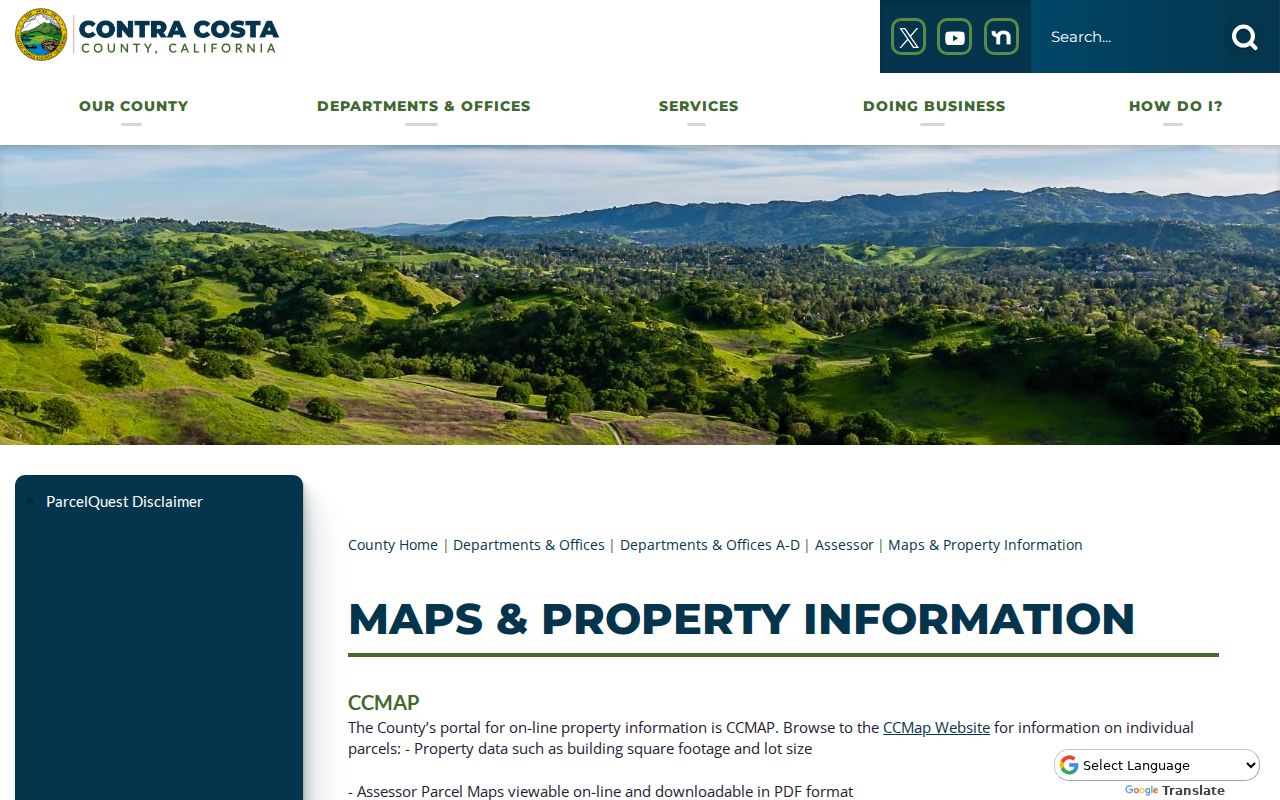
The image shows why the parcel key is useful even when the online owner field is absent: map, APN, building facts, and lot context can guide the next lawful request.
Note: A mailing address can support an owner-occupancy question, but it never proves that every person at the situs is listed there.
Current Oakley Resident Sources
Current resident evidence comes in layers, and each row answers a different question. The strongest directory practice is to name the source and its limit in the same breath. City staff entries are public professional contacts. Permit and code records show a project or enforcement trail. Court and business indexes show a dated public role. Property and deed records show ownership or transactions. None is a complete household roster.
| Source | What It Lists | Keeper | Access |
|---|---|---|---|
| Parcel and assessment data | APN, site facts, values, and lawful owner channel | Contra Costa Assessor | Free web map; counter or request for owner data |
| Recorded-document index | Grantors, grantees, deeds, liens, and maps | Clerk-Recorder | Service hub, copies, and counter |
| City staff directory | Department, title, phone, and email links | City of Oakley | Free web directory |
| Court register | Parties, case roles, dates, and events | Contra Costa Superior Court | Free public index; many files offline |
| License and business files | Public business or credential details | California SOS or DCA | Free searches with source limits |
When the question turns from a source to one person, match the name with a date, parcel, role, or related person before drawing a conclusion. For an Oakley residents directory, those rows are starting points rather than a complete household roll. The Oakley resident lookup workflow keeps that identity check separate from a street-by-street search.
Oakley Court Indexes Stop Before Files
Contra Costa Superior Court’s public portal covers civil, family, small-claims, and probate index data. A result can show a case number, title, type, filing date, party role, judicial officer, hearing date, and register entries. It does not put minutes, orders, case documents, criminal records, or self-represented party addresses on the public screen. Confidential matters, juvenile records, adoption files, and protected family material remain outside the public result.
Search by Last, First and variants, add a filing-date range when the name is common, and keep the location prefix in a full case number. Martinez, Concord, Pittsburg, Richmond, and Walnut Creek prefixes can guide a failed search. Court Records at 1111 Ward Street in Martinez is the in-person fallback; copies and older files may require a written or mailed request. Traffic uses a separate portal, and inactive traffic cases older than three years do not display.
For a federal matter, PACER is the separate route for the Northern District of California. A docket is a timeline, not identity proof. Compare the role, date, parcel, business, or probate connection before treating a same-name result as the Oakley person sought.
Oakley Voter Status Is Not a Directory
California My Voter Status checks the searcher’s own registration with first name, last name, date of birth, and an available identification detail. It returns status, party preference, districts, polling information, and vote-by-mail information for the matched voter. It is not a public by-name or by-street list. California voter affidavits are confidential from routine public display under Elections Code sections 2188 and 2194.
A qualified election, scholarly, journalistic, political, or governmental project may apply for permitted voter-file information. The application requires identity details, a stated use, original signature, identification, and delivery choices. The research notes a 7 to 14 business day review, a $15 per 1,000 records fee with a $15 minimum and $100 maximum, and a specific-voter request price of $30 each up to the stated maximum. A request for everyone on a street is not the same as a permitted specific-voter request.
The California voter-status form is captured below. It demonstrates an identity check, not an Oakley residents directory.
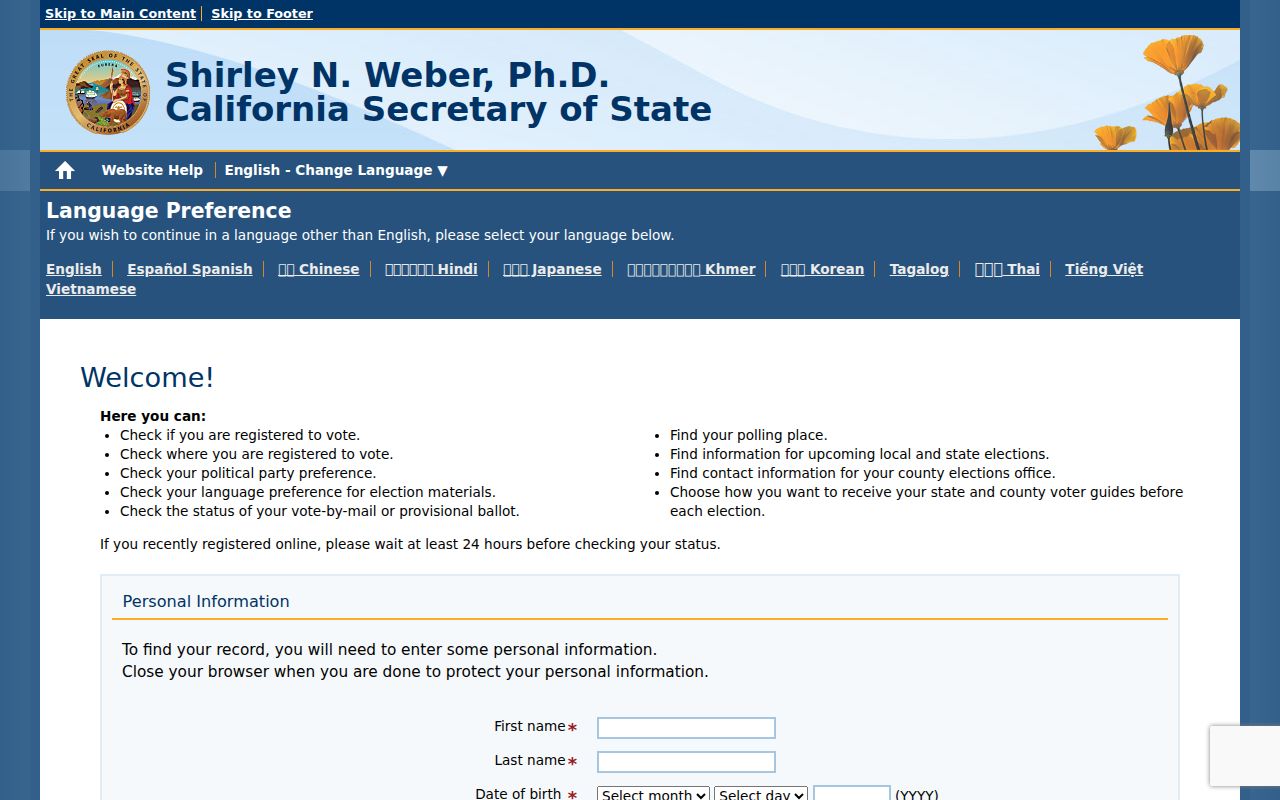
Use parcels, public meetings, historical sources, or voluntary contacts for ordinary neighborhood research. Keep protected addresses and the stated voter-file purpose intact.
Oakley Vital Records Need Eligibility
Birth, death, and marriage certificates come through the Contra Costa Clerk-Recorder or California Department of Public Health Vital Records. Divorce certificates are limited abstracts, while the full decree belongs to the Superior Court. California separates authorized certified copies from informational copies. An informational copy can help with history, but it is marked as not valid to establish identity and does not open confidential marriage, adoption, or original birth material.
For 2026, the CDPH fee schedule lists $31 for birth, $26 for death, $19 for marriage, and $18 for a divorce certificate. A no-record result still uses the search fee. Mail forms ask for event facts, names, dates, place, applicant contact details, relationship, purpose, copies, and payment. Authorized mail requests generally need a notarized sworn statement. County and state processing times should be checked on the day of ordering; the research reports a July 2026 state average of 4 to 6 weeks for certified copies.
Historical indexes, newspapers, church records, cemeteries, and library databases can help locate an event before a certificate request. They are finding aids, not substitutes for the custodian’s eligibility rules.
When Oakley Web Portals Stop
Oakley has two distinct public-record routes. NextRequest handles a CPRA request for records that need to be gathered, while ImageSilo points to already digitized material. A precise request names the date span, department, address or APN, document type, and likely system. The city’s SB 272 catalog can help identify NextRequest or the Citation Processing Center when a code or permit trail is involved.
City Community Development launched the Oakley Civic Access Portal for building and encroachment permits, planning applications, grading and improvement plans, and business or vendor licenses. Records can connect to an account, and the “My Work” area can show status, inspections, fees, documents, reports, and licenses after sign-in. For a closed code case, request records by address and date because complainant details and enforcement-sensitive material may be exempt.
The Oakley records-request gateway is shown in the captured view below.
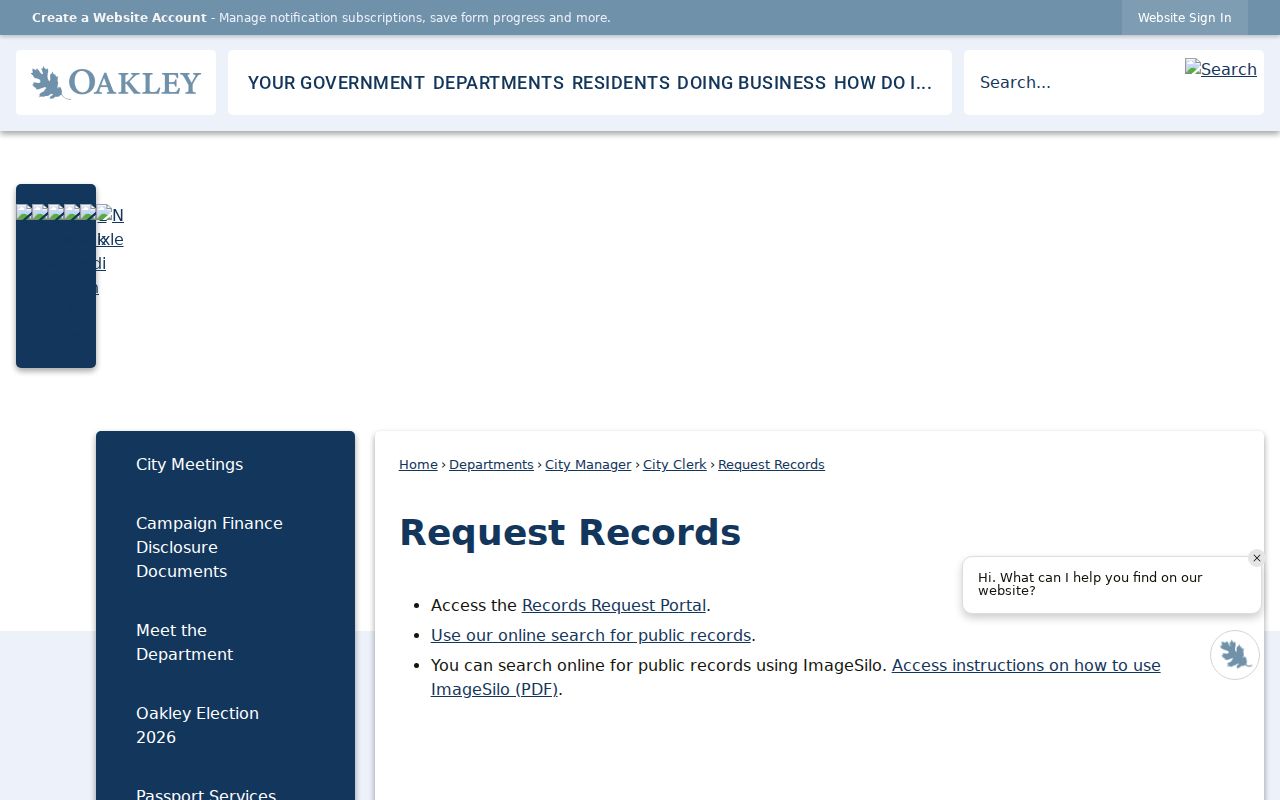
The captured gateway points toward NextRequest and ImageSilo, so a failed public search has a documented city fallback rather than a blank result.
Note: A request asks the custodian for existing records; it does not require staff to create a new list or answer an open-ended question.
Oakley Historical Directory Trails
Oakley’s historical resident directory trail is regional. The city incorporated on July 1, 1999, so earlier evidence sits under Contra Costa County, East County communities, telephone service areas, and four older place labels. The verified Library of Congress telephone directory runs from March 1949 through September 1950 and explicitly includes Oakley. It is a telephone-company white and yellow pages volume, not proof of an exhaustive Polk city-directory run.
Contra Costa County Library supplies catalog discovery, Local History Connection, Ancestry Library Edition in the branch, HeritageQuest or other licensed databases, and newspaper holdings. The Contra Costa Times obituary database reaches back to June 1995 for library cardholders. The historical society adds tax-assessor books from 1850 to 1910, indexed court cases, probate, naturalizations, newspapers, maps, and town subject files. Use a title page and coverage note before claiming that a particular year includes Oakley.
The City of Oakley background page is represented by the captured local-history view.
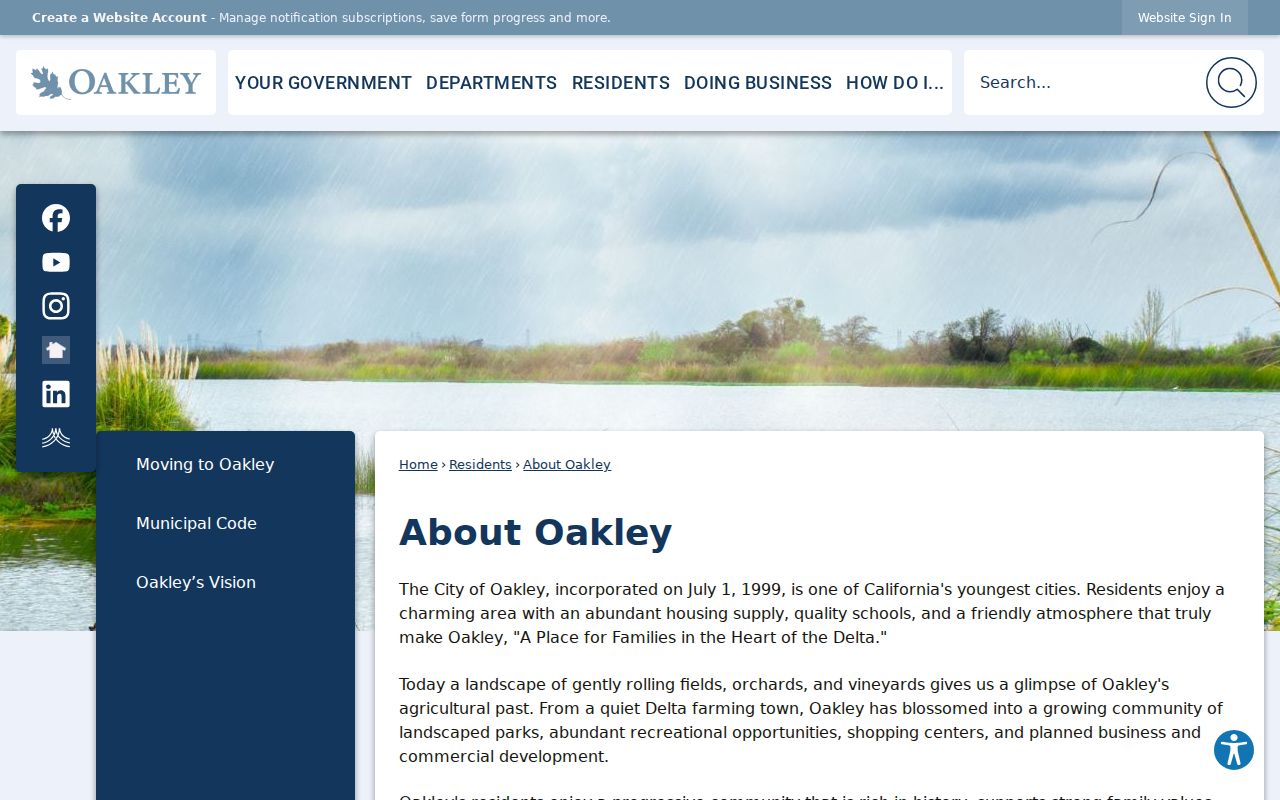
Regional catalog terms such as Antioch, Brentwood, Pittsburg, East Contra Costa, and telephone-company service areas can open shelves that a narrow Oakley search misses. An Oakley residents directory may begin with those historical shelves before it reaches a modern record. The detailed collection trail belongs with the Oakley directory book page.
Oakley’s Four Historic Place Names
Catalogs and censuses may place an Oakley family under Live Oak, Oakley, Iron House, or El Rancho. These four hamlets shaped the town before modern city limits, and the search term “Marsh Landing” can reach still older river and freight references. A name that vanishes from an Oakley city directory may have shifted place labels rather than disappeared.
Street history gives another clue. The 1898 ten-block plat used Main, Acme, Ruby, Star, and Home crossed by First, Second, and Third. The first letters of the five named streets spell MARSH, a useful check when an old map or newspaper scan is hard to read. A modern address should be tested against the legal description, subdivision map, and old place term before rejecting a record.
These local details matter for family research. Agricultural work, packing sheds, rail service, schools, churches, and seasonal camps may appear in census schedules and newspapers even when a person never entered a municipal directory. Search the record form that matches the era, not the directory form that would be most convenient today.
Name to Oakley Address Evidence
A person-name search becomes stronger when two independent records agree on a date, parcel, role, or related person. A deed can connect a name to a transaction. A license can connect a professional role to an address of record. A business filing can connect an entity, agent, and dated filing. An obituary or probate petition can connect a former address to relatives. None should be stretched into a claim about a current home.
Search maiden and married names, initials, reversed surname order, trust or entity vesting, and spelling variants. Check the source’s own identifier, such as a case number, APN, entity number, license number, or instrument number. If a result conflicts with another record, ask the custodian to verify the identifier instead of asking staff to disclose a private person by phone.
California’s DCA license search and the Secretary of State’s bizfile search add useful public cross-checks for civic or business research. The next section shows how those free sources differ from a compiled commercial profile.
Oakley Privacy and Protected Addresses
California’s Safe at Home program supplies a substitute mailing address and confidential mail forwarding for eligible survivors and covered participants. It does not erase every older record, and a legal description can still reveal a parcel. Protected-voter rules, confidential marriages, adoption files, driver information, and certain public-official addresses have their own limits. Contra Costa’s online owner suppression is one practical response to those privacy needs.
Lawful use. Oakley records support family history, civic research, estate work, and personal record checking. Never use a name or address trail to stalk, harass, threaten, or harm a person, and stop when a custodian identifies a protected record.
California’s CPRA generally gives a right to inspect nonexempt public records, but an agency need not create a new record and may redact protected material. Ask the right office, use a narrow date and record description, and respect a denial that rests on a stated exemption.
Free Oakley Business Cross-Checks
California’s bizfile search is useful for an entity name or file number. Its results can show an entity number, formation date, status, jurisdiction, street or mailing address, agent details, and filing images. The research notes more than 17 million free PDF filings, default results of up to 500 closest matches, and limits on ownership, phone, email, subsidiary, and online LLP or GP coverage. A filing shows a public business connection on a date, not a personal residence.
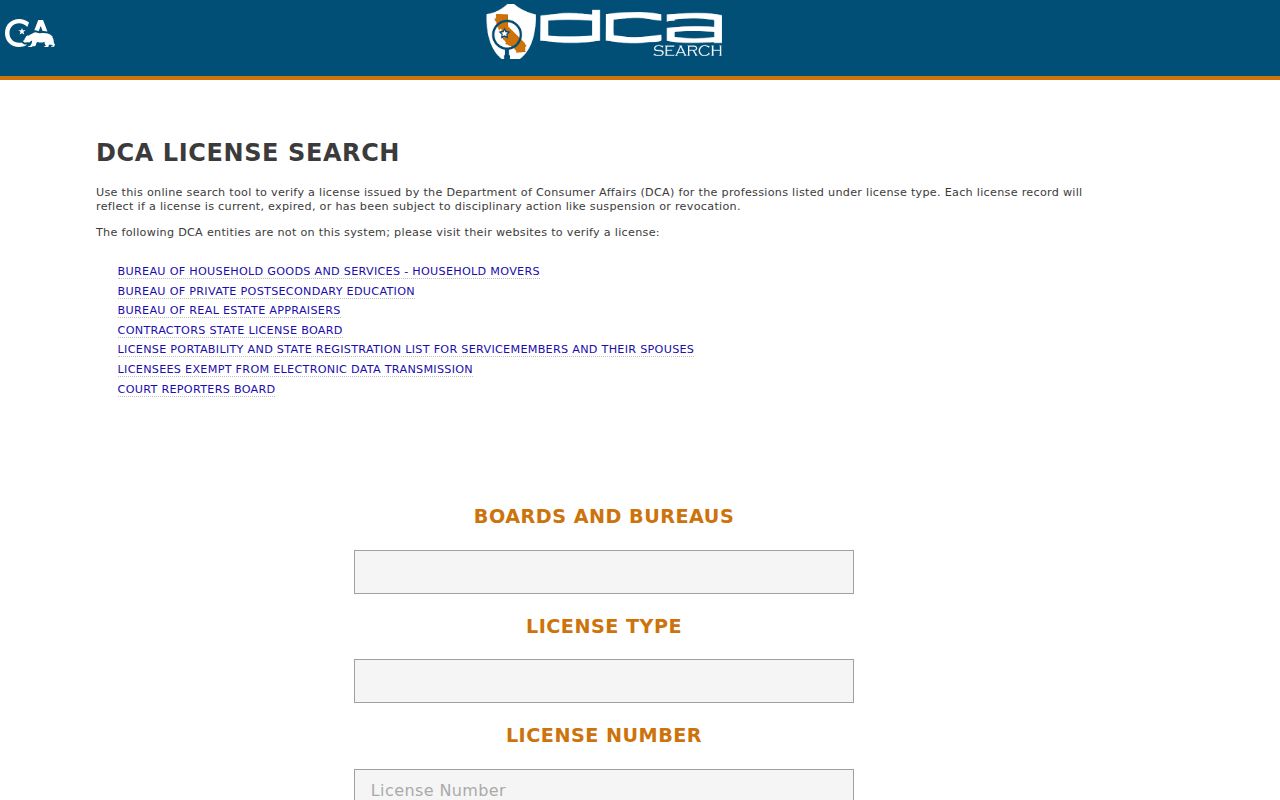
The DCA umbrella search can lead to a board result with license number, type, status, issue or expiration dates, public address, and discipline links where available. Open the issuing board record before relying on a match. A city business license request, fictitious business name file, or professional board result may all describe the same person differently, so compare dates and identifiers.
The California license-search page is shown below as an official state cross-check.
Bizfile supplies a second kind of public cross-check, focused on entities and filings.
California’s bizfile search is represented by the captured state business-search view.
Used together, official rolls and free state lookups can test a clue without turning a single name into an unsupported conclusion.